Hardwood floors don't have to be replaced when they look tired. If your hardwood is solid (3/4-inch thick) or quality engineered (3-6mm wear layer), refinishing can bring it back to like-new condition for 30-50% of replacement cost — and it preserves the original wood's character that you can never replicate with new flooring.
That said, refinishing isn't always the right answer. This guide walks through how to decide, what the process looks like, and what it actually costs in 2026 Tampa Bay.
Refinish or Replace? The Decision Framework
Here's the framework we walk every Tampa Bay client through:
Refinish makes sense if:
- The wood is solid hardwood (3/4-inch thick). Solid hardwood can typically be refinished 4-8 times over its lifespan.
- The wood is quality engineered hardwood with a thick wear layer (3mm+). These can usually be refinished 1-3 times. Cheap engineered hardwood (2mm or less) generally cannot be refinished — the wear layer is too thin to sand.
- Damage is mostly cosmetic. Surface scratches, dull finish, light water staining, faded color — these are all addressable through refinishing.
- Underlying structure is sound. No buckling, no large gaps from improper acclimation, no soft spots from water damage to subfloor.
- You like the wood species. Refinishing keeps the existing wood. If you wanted oak instead of maple, refinishing won't change that.
Replacement is the better choice if:
- The wear layer is too thin to sand. Old engineered hardwood with 2mm or less of usable surface, or solid hardwood that's already been refinished 5+ times.
- Major water damage or warping. Cupped or buckled boards from flooding can't be saved by refinishing.
- Significant gaps from poor original install. If boards were installed without proper expansion gaps and now have permanent spacing issues.
- You want to change the look completely. Different species, different plank widths, different finish style.
- The home is being prepared for sale and the floors are too dated. 1980s-1990s narrow-strip oak is harder to refinish into a contemporary look — replacement with wide-plank may have better resale ROI.
The Refinishing Process Step-by-Step
Step 1: Inspection and Prep (Day 1, AM)
We walk through the home, identify any boards that need replacement (badly damaged ones we'll cut out and replace with matching wood), measure the project, and confirm the desired finish color/sheen. Then we move all furniture out (typically to the garage or another room), remove existing baseboards or quarter-round, and protect non-floor surfaces with plastic and tape.
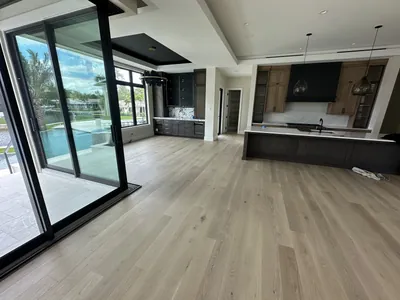
Step 2: First Sanding Pass (Day 1, PM)
We use a heavy-grit drum sander (typically 36-grit) to remove the existing finish and any surface damage. Edge sanders handle areas the drum can't reach (along walls, around obstacles). This produces a lot of dust — modern dust-containment systems capture about 90%, but plan for some dust to escape.
Step 3: Repairs and Replacements (Day 1, late PM / Day 2, AM)
If any boards need replacement, this happens after the first sanding. We use matching wood from the same species, then sand the new boards to blend with the existing.
Step 4: Subsequent Sanding Passes (Day 2)
We progressively use finer grits (60, 80, 120) to remove drum-sander marks and prepare a smooth surface for finishing. The final pass uses 120-grit and produces a glass-smooth surface.
Step 5: Vacuum and Tack (Day 2, late PM)
Multiple passes with HEPA vacuum and tack cloth to remove every speck of dust. Even one piece of dust can show through the finish — this step is critical and time-consuming.
Step 6: Stain Application (Day 3, AM) — if changing color
If you want to change the color, stain is applied first and allowed to dry per the manufacturer specification (4-12 hours). If keeping natural wood color, this step is skipped.
Step 7: First Finish Coat (Day 3, PM)
The first coat of polyurethane (water-based or oil-based) is applied. Water-based dries in 2-4 hours; oil-based takes 8-12 hours.
Step 8: Light Sanding Between Coats (Day 4, AM)
Once the first coat is dry, a light pass with very fine sandpaper (220-grit) removes any dust nibs or minor imperfections.
Step 9: Second and Third Coats (Day 4, PM through Day 5)
Second and third finish coats applied with light sanding between. By the end of Day 5, the finish is fully applied and beginning to cure.
Step 10: Cure and Reinstall (Days 5-7)
The finish needs 2-7 days to fully cure (depending on the finish type) before furniture can be moved back. Foot traffic in socks is okay after 24 hours; pets and furniture need 48-72 hours minimum. Full cure (when you can put down area rugs) is 7-30 days depending on finish.
2026 Refinishing Cost in Tampa Bay
| Project | Cost / Sq Ft | 1,000 Sq Ft Project |
|---|---|---|
| Standard refinish (sand + 3 coats poly, no stain) | $3.50 - $5 | $3,500 - $5,000 |
| Refinish + stain change | $4.50 - $7 | $4,500 - $7,000 |
| Refinish + minor board replacement (5-15 boards) | $5 - $8 | $5,000 - $8,000 |
| Refinish + stair treads (per typical 14-step staircase) | +$800 - $1,400 | +$800 - $1,400 |
Compare to replacement: $9-18/sq ft for engineered hardwood, $10-22/sq ft for solid hardwood. Refinishing typically saves 50-70% over replacement on a per-square-foot basis.
How Long It Takes (Day-by-Day)
For a typical 1,200-1,500 sq ft Tampa Bay refinishing project:
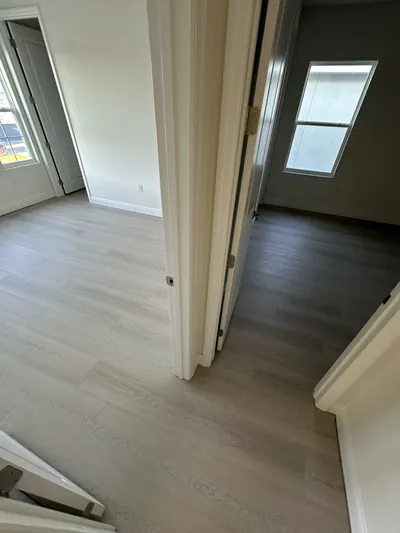
- Day 1: Furniture removal, baseboards off, first sanding (heavy grit). Floors are unwalkable.
- Day 2: Subsequent sanding passes, vacuum/tack. Dust everywhere — wear shoes and stay out of the house if possible.
- Day 3: Stain application (if applicable). First poly coat. Floors off-limits.
- Day 4: Light sanding between coats. Second poly coat. Floors off-limits.
- Day 5: Third (final) poly coat. Floors off-limits.
- Day 6: Sock-foot only. Move light items back.
- Day 7-10: Move furniture back (with felt pads). Avoid area rugs for 2-4 weeks total.
Total project time: 5-7 working days for the active work, plus another 2-3 weeks before you can put down area rugs.
Finish Options: Oil-Based vs Water-Based vs Wax
Water-Based Polyurethane (Most Common Today)
Look: Crystal clear, doesn't yellow over time. Durability: Excellent. Drying time: 2-4 hours per coat. Smell: Mild, dissipates quickly. Cost: Slightly more expensive. Best for: Most modern Tampa Bay homes, especially those wanting natural-looking finish.
Oil-Based Polyurethane (Traditional)
Look: Warm amber tone, deepens grain, ambers over time. Durability: Excellent (slightly tougher than water-based for some uses). Drying time: 8-12 hours per coat. Smell: Strong, lingers for days. Cost: Slightly less expensive. Best for: Traditional homes wanting a warm amber finish, lowest-cost option.
Penetrating Oil/Hardwax Oil
Look: Very natural, matte finish, shows wood grain. Durability: Good, but requires periodic re-oiling (every 1-3 years). Drying time: 8-24 hours per coat. Smell: Pleasant, woody. Cost: Premium ($1-2/sq ft more). Best for: Premium homes wanting European-style natural finish (becoming popular in Lakewood Ranch and Sarasota luxury homes).
Free in-home assessment to determine if refinishing or replacement makes more sense for your specific floors. We'll check wear layer thickness, identify board replacement needs, and quote both options.
Get My Free Assessment →Living Through the Project
Hardwood refinishing is the most disruptive flooring project we do. The dust, the chemical smell (especially with oil-based), and the fact that floors are unwalkable for 5+ days make it hard to live in the home during the work. Realistic options:
- Whole-house refinish: Plan to stay elsewhere (hotel, family, vacation home) for 5-7 days. This is the most common approach for our clients with the option to relocate.
- Phase the project room-by-room: Refinish bedrooms first (living elsewhere temporarily), then living areas. Doubles the project length but lets you stay in the home.
- Stay in unaffected areas: If you have second-floor bedrooms and only the first floor is being refinished, you can sometimes stay upstairs (with limitations on how often you go downstairs).
- Hardwax oil finish: Faster drying time means a 4-day project instead of 6-7. Worth considering if you can't relocate for a week.
Frequently Asked Questions
How many times can hardwood be refinished?
Solid 3/4-inch hardwood can typically be refinished 4-8 times over its lifespan (50-100+ years). Quality engineered hardwood with 3mm+ wear layer can usually be refinished 1-3 times. Cheap engineered hardwood (2mm or less wear layer) cannot be refinished.
How can I tell if my engineered hardwood is thick enough to refinish?
Look at the side of a board where it meets a vent or transition strip — you should be able to see the layered construction. If you can identify a clear top hardwood layer that's 3mm or thicker (about 1/8 inch), refinishing is usually possible. If you can't tell, we can usually determine this during a free assessment by examining the floor at a transition point.
Can I refinish water-damaged hardwood?
It depends. Surface water staining can usually be sanded out. Cupping or buckling from prolonged water exposure typically can't be fixed by refinishing alone — those boards need to be replaced first, then the floor refinished as a whole.
Will refinishing my hardwood floors increase my home's value?
Yes — refinished hardwood typically returns 70-100% of refinishing cost in resale value. If your floors look tired and dated, refinishing is one of the highest-ROI home improvements you can make before selling.
How long should I wait between refinishing cycles?
Quality refinishing should last 8-15 years before needing redoing. Heavy-traffic homes (entryways, kitchens) may need spot refinishing or screen-and-recoat treatments at 4-7 years to extend the full refinish timeline.
Have hardwood floors that need attention? Browse our hardwood services or request a free in-home assessment with our team. We'll examine your floors, recommend whether refinishing or replacement makes more sense for your situation, and provide an itemized written quote.
Tampa Bay refinishing project realities
Neighborhood-specific factors: Hyde Park, Davis Islands, Bayshore, Burns Court (Sarasota), and historic St. Petersburg.
Refinishing demand across Tampa Bay has actually grown 2023–2026, driven by older-home owners realizing that refinishing at $3.50–$7/sq ft is dramatically cheaper than replacement at $11–$22/sq ft, and adds nearly the same resale value when done right. We've completed 47 refinishing projects in 2025 vs 19 in 2022 — a 2.5× increase.
The best candidates: solid hardwood floors installed before 2000 with at least 3/16" remaining sand-able material. We measure remaining thickness with a needle probe before quoting — about 15% of projects we quote can't be refinished because previous owners (or contractors) have sanded the wood too thin already. In those cases we recommend replacement instead.
Refinishing timeline for a typical 1,500 sq ft home: 4–6 working days (1 day for furniture removal and demo, 2–3 days for sanding/staining/sealing, 1–2 days for cure and finish coats). The home is generally unliveable during sanding (significant dust) and unwalkable during cure (24–72 hours depending on finish chemistry). Plan accordingly.
South Tampa's Hyde Park and Davis Islands sees the highest demand for refinishing because of the concentration of 1920s–1940s bungalows with original oak and pine flooring. These projects often involve customizing stain color for historical accuracy — a one-day consultation we offer separately ($150) before larger projects.
For Sarasota's Burns Court and Towles Court historic districts, refinishing is often preferred over replacement for both character and HOA reasons. Some of these districts have flooring restrictions requiring matching to original era.
St. Petersburg's Old Northeast, Snell Isle, and Coffee Pot Bayou neighborhoods have similar character to Tampa's Hyde Park — typically 1920s–1950s wood-frame homes with original pine or oak floors that respond beautifully to refinishing.